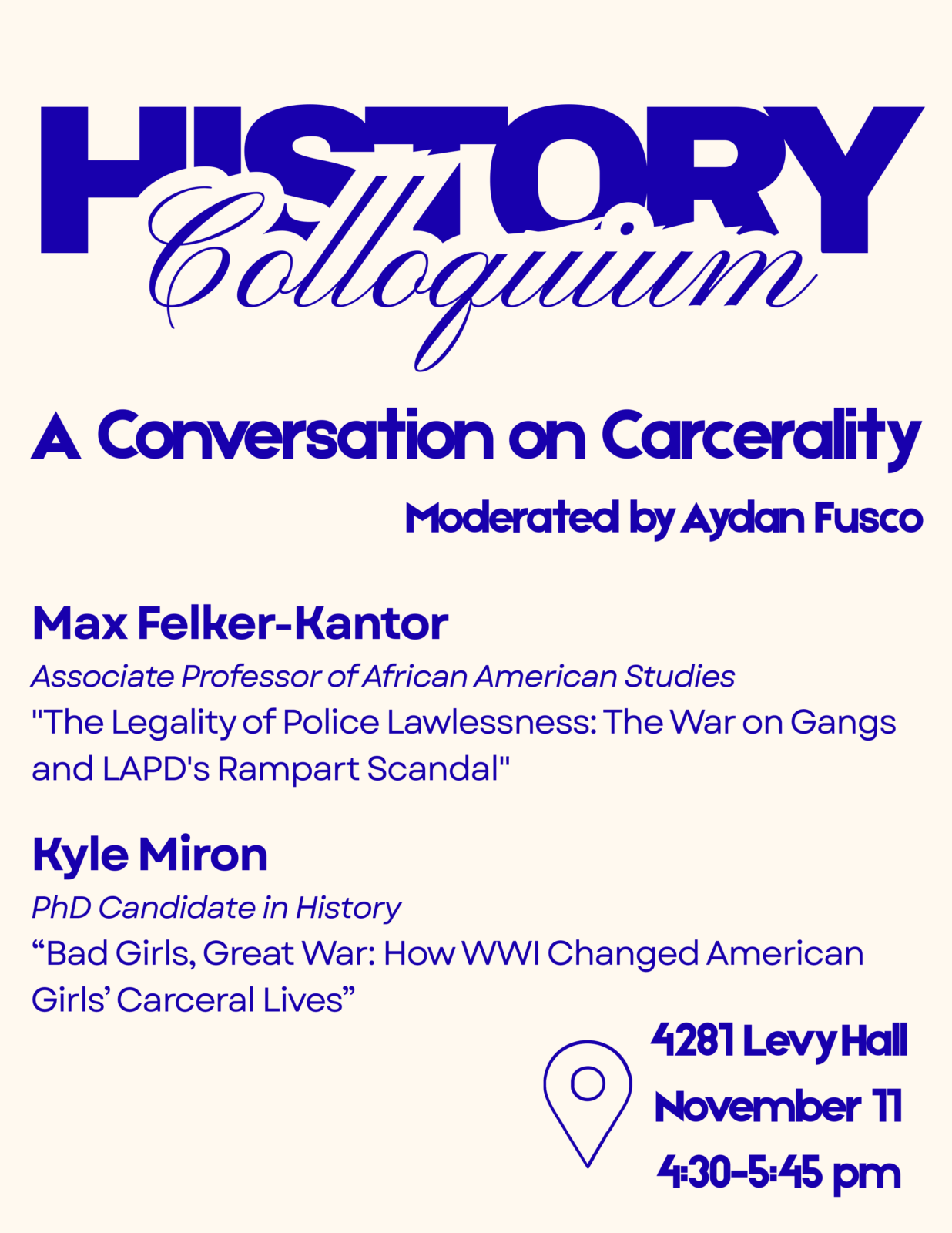
A Conversation on Carcerality
Max Felker-Kantor and Kyle Miron
Irving & Dorothy Levy Hall #4281
Max Felker-Kantor, Associate Professor of African American Studies
“The Legality of Police Lawlessness: The War on Gangs and LAPD’s Rampart Scandal”
In this talk, which is based on my book manuscript entitled Lawless: The War on Gangs and the LAPD’s Rampart, I will examine the war on gangs of the 1990s and the Los Angeles Police Department’s (LAPD) Rampart Scandal. The Rampart scandal involved the department’s anti-gang CRASH (Community Resources Against Street Hoodlums) unit. Their alleged crimes included stealing drugs and money from suspects, questionable shootings, use of excessive force, planting evidence, framing subjects, and giving false testimony in court. The repercussions of the scandal were staggering and long-lasting. Alongside nine officers indicted on criminal charges, an estimated 86 Board of Rights hearings, nearly 400 administrative complaints, the dismissal of approximately 156 felony convictions, and tens of millions of dollars paid to settle more than 200 civil suits, the scandal led the city to enter an agreement with the Department of Justice establishing a federal consent decree mandating dozens of reforms and external monitoring and oversight, which remained in place from 2001 to 2013.
In this talk, I will explore the framework I call the legality of police lawlessness. Focusing on how the police defined who and what constituted crime, it explains how and why Rampart was more than mere corruption. Using the legality of police lawlessness as a framework centers the police in producing crime and violence. It was this lawlessness that provoked a crisis of police legitimacy. To explore this framework, I will focus on the specifics of the war on gangs in the 1990s.
Kyle Miron, PhD Candidate in History
“Bad Girls, Great War: How WWI Changed American Girls’ Carceral Lives”
Twin panics emerged at the outbreak of WWI—that women would transmit venereal disease to soldiers and that war would cause a juvenile crime wave. One arena where women were in control of efforts to manage teen girls’ sexual relationships with soldiers was in YWCA hostess houses. In this presentation I argue that teen girls were central to the hostess houses’ layered mission and that they were the figures who most complicated their project. Hostesses called on teen girls to perform sexual allure for soldiers or give soldiers the image of a girl back home to fight for but struggled as teen girls acted outside of the roles ascribed to them by the YWCA or the military. Examining their efforts to manage these girls makes clear that the hostess house project was fundamentally impossible, an impossibility that was passed on to adolescent girls. I bring together women’s history, carceral history, and childhood studies to build on historians who have described WWI policing as a story of repression and resistance. Instead, I suggest that the back and forth between reform-minded women and teen girls created new standards for behavior and new strategies for running carceral institutions.