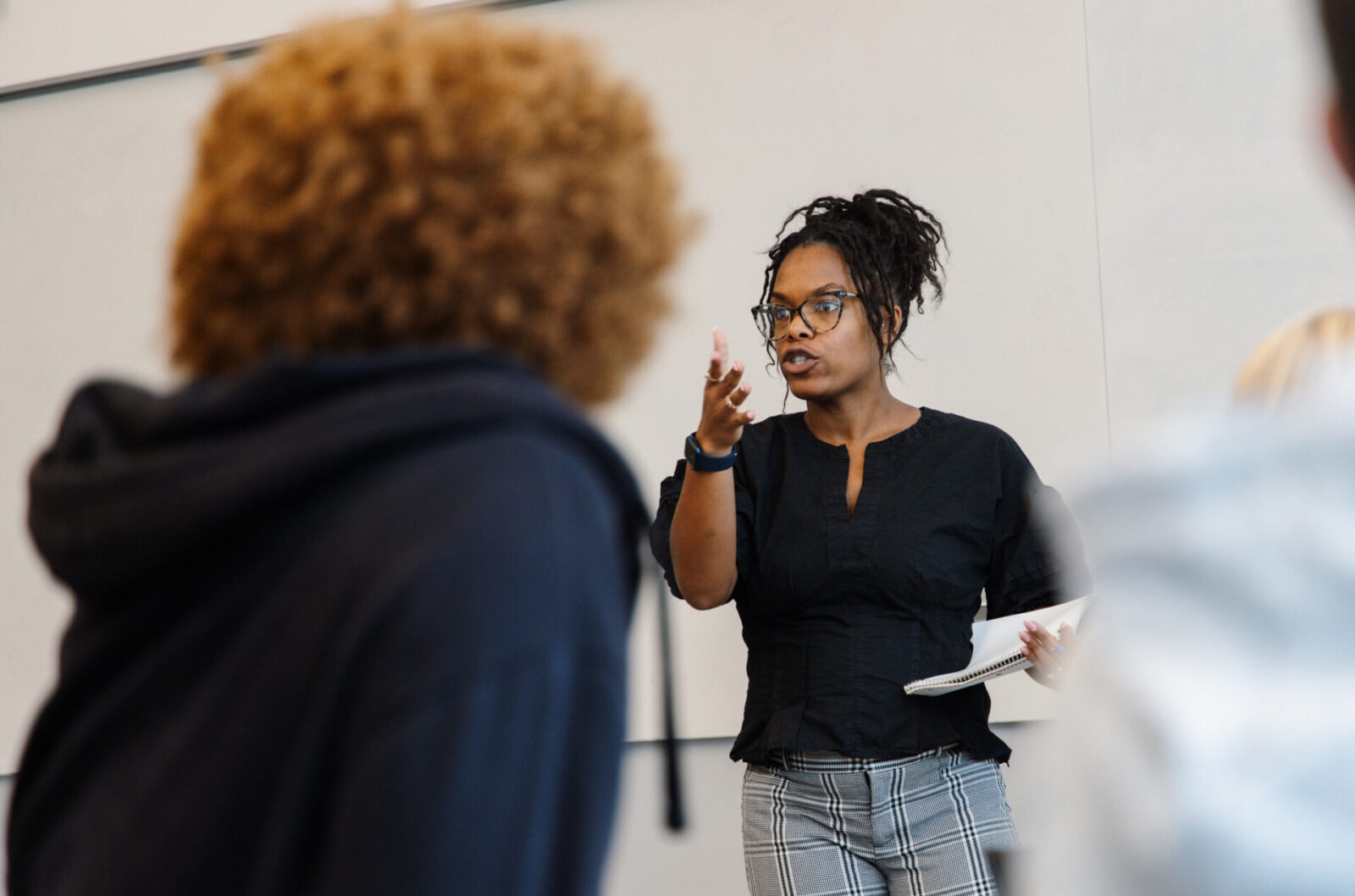
An interdisciplinary approach to education
Study Black political theory, literature, art history, theatre, education, Black history, and sociology to develop skills in multicultural humility, research, cultural literacy, and critical inquiry.

Think critically and embolden communities
Conduct public humanities research to engage deeply in social collaboration and activism. Learn to think critically and embolden communities.

Collaboration in community
Recognize the collective power of partnerships in organizing to actively seek growth and deliberate change within societies.
Committed to bringing academic research to the broadest possible audience, the Department of African American Studies at UW–Madison believes the deepest understanding of the complex reality of race in America requires a truly interdisciplinary approach. Within and beyond the walls of the university, our studies draw on history, literature, the social sciences, and the arts.
Approved by the Board of Regents in 1970, the Department of African American Studies (formerly Afro-American Studies) is an outgrowth of the student concern for relevance in higher education which was so dramatically evidenced on many college campuses during the late 1960s. Today, the department offers a wide variety of courses leading to both undergraduate and graduate degrees and is one of the most successful programs in the country.
Scholarship Opportunity: Jewish Studies & African American Studies
This scholarship provides financial support to a student pursuing coursework in both African American studies and Jewish Studies. Learning about African Americans and Jews will encourage students to delve into the history of two minority groups whose distinct experiences illuminate questions of race and ethnicity.

Student Symposium
Hosted every February, the African American Studies symposium is open to undergraduates and graduates students from any discipline whose work centers or intersects with Black studies and Black people.

The SoulFolk Collective
Housed within the Department of African American Studies, this multidisciplinary research lab prioritizes Black-affirming methodologies that amplify the voices, stories, and lived realities of Black communities.

Essence Learning Community
Essence, a mixed co-ed residence floor in Witte, welcomes all students interested in learning about the Black diaspora and impacted peoples through events, dialogue, and community-building.

The Black Cultural Center
The BCC welcomes all students interested in understanding and supporting the experiences, and dynamic lives of Black undergraduate, graduate, and professional students. The BCC connects communities to the larger Wisconsin Experience to foster a sense of belonging.
Events
-
Oct 27
-
Oct 28
-
Oct 29
-
Nov 10
-
Nov 11
News
-
1776/2026 Lecture Series: Two Concepts of Patriotism: Nationalist and Civic
This special event with Professor Desmond Jagmohan (University of California, Berkeley) is part of “1776/2026: The Declaration at 250”, a year-long series of campus events and public conversations. It is presented in…
-
Ethnic Studies Fest
Kick off the 2026-2027 school year with us on September 18th for the Ethnic Studies Fest! 🪩 Make new, meaningful connections with peers and faculty as we break bread and break-in our…
-
We are hiring: Reader/Graders
The Department of African American Studies is currently seeking multiple Reader/Graders in the following courses: ‣ AAS151: Intro to Contemporary African American Society — Learn more and apply here. ‣ AAS242: Intro…
-
Article published in AFRO News on Dr. Whitmire’s research process
Victoria Mejicanos, an AFRO News staff writer, interviews Dr. Ethelene Whitmire on her process of researching Reed Peggram, a Black queer Harvard scholar whom Whitmire recently published a book on “I just…
-
We’ve moved!
We have a new home! We parted ways with Helen C. White this summer and are now located in Irving & Dorothy Levy Hall on the corner of Park St and Johnson…

1969 Black Student Strike

Black students at UW–Madison called for a campus-wide student strike in the spring of 1969. The strike was a culmination of three years of meetings, negotiations, protests, and frustrations with the administration for their negligible response to the need to engage in anti-racist developments on campus.
Students held rallies to educate the community about racial inequities, boycotted classes, marched to the state Capitol, took over lecture halls, and blocked building entrances. They gave a list of 13 demands, the first of which was the creation an autonomous Black studies department that was controlled and organized by Black students and faculty. This was a non-negotiable term.

FACULTY
People
Our award-winning faculty and staff have a breadth of expertise in the arts, humanities, and the social sciences that make their approach to research and education dynamic.

est. 1970
History
The Department of African American Studies offered its first classes during the fall of 1970, one year after the Black Student Strike of 1969.

SCHOLARSHIPS, news, and events
Resources
We collaborate closely with other departments and programs on campus to bring students an integrative education.

Programs
Education
We offer a certificate, B.A., B.S., M.A., a Ph.D. minor, and opportunities to engage in public humanities research.

INTERDISCIPLINARY TOPICS
Courses
An interdisciplinary study of African American, African diaspora and African history, society, and culture.
DONATE
Support our work
We express immense gratitude to those who support and aid in our fundraising efforts.
Give a gift to African American Studies
We promote collaboration, dialogue, and community through our scholarship and advocacy in Black studies. The support from our community partners is invaluable. Learn more about our three funds, and consider aiding us in our mission.